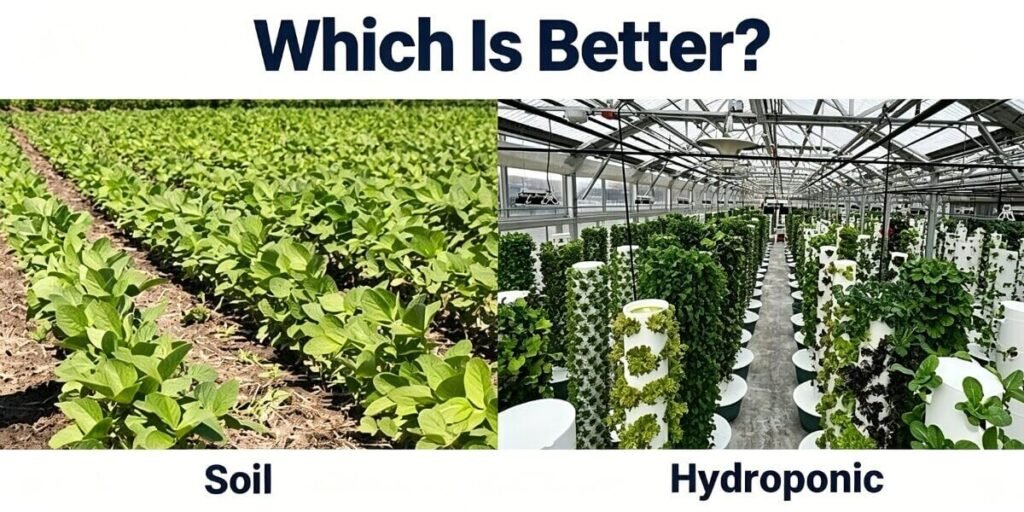

Thinking about starting a garden but not sure whether to choose hydroponics vs soil?
Both methods can grow healthy, productive plants, but they create very different growing experiences. Hydroponics delivers water and nutrients directly to plant roots, while soil gardening relies on a natural ecosystem to support plant growth.
In this guide, we’ll compare hydroponics vs soil in terms of growth speed, yield, cost, maintenance, water efficiency, sustainability, and more, helping you choose the growing method that best fits your space, budget, and gardening goals.
What Is Hydroponics?
If you’ve ever seen vegetables growing without soil, you’ve already seen hydroponics in action.
Instead of drawing water and nutrients from the ground, hydroponic plants receive everything they need through a nutrient-rich water solution. Depending on the system, the roots may grow directly in water or be supported by growing media such as coco coir, rockwool, or clay pebbles.
Because growers can precisely manage water, nutrients, oxygen, and the root environment, hydroponics often delivers faster growth, higher yields, and more efficient use of water and space. The trade-off is that it requires regular monitoring to keep the system running smoothly.
What Is Soil Gardening?
For most people, soil gardening is the way they first learn to grow plants.
Plants grow naturally in soil, where their roots absorb water and nutrients while benefiting from organic matter and beneficial microorganisms. Healthy soil not only anchors plants but also stores moisture, recycles nutrients, and supports a thriving ecosystem beneath the surface.
One of the biggest advantages of soil gardening is its simplicity. It requires less equipment and is generally easier for beginners, although plant growth depends more on soil quality, weather, and routine garden care throughout the season.
Comparing Hydroponic and Soil Gardening: What Matters Most
Choosing between hydroponics and soil gardening is not simply about growing plants with or without soil. Each method creates a different growing experience, and the better choice depends on factors such as your available space, budget, gardening goals, and how much control you want over the growing process.
To make this comparison clear, we looked at the areas that matter most to everyday growers, including growth speed, crop yield, water efficiency, nutrient management, cost, maintenance, sustainability, and ease of use.
The comparison below provides a quick overview of how hydroponics and soil gardening differ before we explore each factor in more detail.
Hydroponics vs Soil Gardening: Quick Comparison
Still deciding between hydroponics and soil gardening? A quick comparison can help you understand the main differences before choosing the right growing method for your needs.
Both systems can produce healthy and productive plants, but they work in different ways. Hydroponics offers greater control over water, nutrients, and growing conditions, while soil gardening provides a more natural growing environment with lower startup costs.
The table below highlights the key differences between hydroponics and soil gardening, including growth, cost, maintenance, water use, and overall growing experience.
Key Differences at a Glance
| Feature | Hydroponics | Soil Gardening |
|---|---|---|
| Plant Growth Speed | Faster growth with controlled water, nutrients, and root conditions | Slower growth but more forgiving for beginners |
| Crop Yield | High productivity, especially in controlled environments and limited spaces | Depends on soil quality, climate, and growing conditions |
| Initial Investment | Higher upfront cost for equipment such as reservoirs, pumps, and lighting | Lower startup cost with basic tools and soil |
| Long-Term Cost | Lower water use and efficient resource management, but may require electricity and nutrients | Lower equipment costs but may require fertilizers, compost, and soil improvement |
| Maintenance | Requires monitoring of pH, nutrients, water levels, and system performance | Requires watering, weeding, soil care, and pest management |
| Learning Curve | Requires basic knowledge of nutrient management and system operation | Easier for beginners due to familiar gardening methods |
| Water Efficiency | Uses water more efficiently through recirculating systems | Requires more water depending on soil and weather conditions |
| Nutrient Delivery | Precise nutrient control through balanced solutions | Relies on soil fertility and natural nutrient cycles |
| Space Efficiency | Excellent for indoor gardens, vertical systems, and urban growing | Requires more open space for many crops |
| Pest & Disease Risk | Fewer soil-related problems but requires careful root and water management | More exposure to weeds, soil pests, and soil-borne diseases |
| Environmental Impact | Efficient use of water and growing space | Supports biodiversity and natural soil ecosystems |
| Best For | Indoor growing, vertical gardens, year-round production, commercial farming | Outdoor gardens, beginners, and traditional gardening |
| Growing Medium | Nutrient-rich water with optional inert growing media | Natural soil with organic matter and microorganisms |
Before deciding which method is right for you, it is important to understand that neither hydroponics nor soil gardening is universally better. The best choice depends on your growing environment, the crops you want to grow, and the type of gardening experience you prefer.
Growth Speed and Plant Development
If faster harvests are your goal, hydroponics often has the advantage.
Many plants especially leafy greens and herbs grow more quickly in hydroponic systems because water, nutrients, and oxygen are delivered directly to the roots. In soil, roots must naturally search for these resources, making growth more dependent on soil quality and environmental conditions.
Why Hydroponic Plants Often Grow Faster
The biggest advantage of hydroponics is consistency. Growers can control nutrient levels, water supply, and root-zone oxygen, helping plants grow under stable conditions with fewer interruptions. This is why crops such as lettuce, basil, and spinach often reach harvest sooner than the same varieties grown in soil.
How Root Conditions Affect Plant Growth
The biggest advantage of hydroponics is consistency. Growers can control nutrient levels, water supply, and root-zone oxygen, helping plants grow under stable conditions with fewer interruptions. This is why crops such as lettuce, basil, and spinach often reach harvest sooner than the same varieties grown in soil.
Does Faster Growth Always Mean Better Harvests?
Not necessarily. Growth speed is only one part of successful gardening. A healthy soil garden can still produce excellent crops, while a poorly managed hydroponic system may struggle. Factors such as light, temperature, plant variety, and overall care have just as much influence on the final harvest as the growing method itself.
Which Growing Method Produces Faster Results?
Hydroponics is generally the better choice if your priority is faster growth and more frequent harvests. Soil gardening grows plants more naturally and may take longer, but it remains a reliable option for gardeners who value simplicity and lower startup costs.
Crop Yield and Growing Productivity
If maximizing your harvest is the goal, hydroponics often has the advantage.
Both hydroponics and soil gardening can produce healthy, productive plants, but yield depends on factors such as crop type, growing conditions, and how efficiently resources are used. Hydroponics typically performs better where space is limited, while soil gardening can produce equally impressive harvests when space and growing conditions are favorable.
Why Controlled Growing Conditions Can Increase Yield
Hydroponic systems provide a consistent supply of water, nutrients, and oxygen, allowing plants to grow with fewer interruptions. Combined with vertical growing systems and greenhouse production, this controlled environment can significantly increase yields per square meter.
Which Plants Perform Best in Hydroponic Systems?
Leafy greens such as lettuce, spinach, kale, and herbs are among the highest-yielding hydroponic crops. Fruiting plants like tomatoes, cucumbers, peppers, and strawberries also perform well with proper lighting and nutrient management. Soil remains the better choice for many root vegetables, large vines, and perennial crops that require deeper root systems or more growing space.
Which Method Is More Productive?
Hydroponics is generally the better option for maximizing yield in limited space or controlled environments. Soil gardening remains highly productive for outdoor gardens and crops that naturally thrive in the ground. The best choice depends on the types of plants you want to grow and the space available.
Water Use and Growing Efficiency
If conserving water is a priority, hydroponics usually has the advantage.
Although plants grow in water, most hydroponic systems use it more efficiently than traditional soil gardens. By delivering water directly to the roots and recirculating unused solution, hydroponics minimizes evaporation, runoff, and waste while maintaining healthy plant growth.
Why Hydroponic Systems Use Less Water
Most hydroponic systems continuously recycle water through a reservoir. Plants absorb the water and nutrients they need, while the remaining solution is returned to the system for reuse. This closed-loop approach greatly improves water efficiency, especially in indoor gardens and regions where water is scarce.
How Soil Gardening Can Improve Water Efficiency
Yes. Healthy soil can retain moisture effectively when managed with compost, mulch, and efficient irrigation methods such as drip watering. However, water use in soil gardens is more influenced by weather, soil type, and drainage, making it harder to control than in a hydroponic system.
Which Growing Method Saves More Water?
Hydroponics is generally the better choice for reducing water consumption. Its recirculating systems make efficient use of every drop, making it ideal for water-conscious gardeners, urban growers, and controlled growing environments. Soil gardening can also be sustainable, but achieving similar water efficiency usually requires more careful management.
Nutrient Delivery and Plant Nutrition
If precise nutrient management is important to you, hydroponics has a clear advantage.
Both hydroponics and soil gardening can produce healthy plants, but they supply nutrients in different ways. Hydroponics delivers nutrients directly through a balanced water solution, while soil gardening relies on natural processes that gradually release nutrients from organic matter and beneficial microorganisms.
How Do Plants Receive Nutrients?
In hydroponic systems, nutrients are dissolved in water and delivered directly to the roots, making them immediately available for plant uptake. This allows growers to adjust nutrient levels throughout different stages of growth using tools such as pH and EC meters. In soil gardens, nutrients become available more gradually as organic matter decomposes and soil microorganisms release minerals into the root zone.
Which Method Creates Better Growing Conditions?
Hydroponics is the better choice for growers who want precise control over plant nutrition and consistent growing conditions. Soil gardening is ideal for those who prefer working with a natural soil ecosystem and improving soil fertility over time. Both methods can produce healthy, productive plants when managed properly.
Root Health and Overall Plant Performance
If your goal is to grow healthy, vigorous plants, both hydroponics and soil gardening can deliver excellent results.
The biggest difference is how each method supports plant health. Hydroponics creates a highly controlled environment where water, nutrients, and oxygen are carefully managed, while soil gardening relies on a living ecosystem that naturally supports root development and nutrient cycling.
How Does Each Method Support Healthy Growth?
In hydroponic systems, roots receive a consistent supply of water and nutrients, making it easier to maintain stable growing conditions. This level of control can reduce plant stress and promote steady growth, especially for leafy greens and herbs.
In soil gardens, plants benefit from organic matter, beneficial microorganisms, and natural nutrient cycles. Healthy soil not only feeds plants but also helps build resilience over time, creating a balanced environment for long-term growth.
Which System Supports Healthier Plants?
Neither method is inherently healthier than the other. Hydroponics offers greater control and consistency, while soil gardening provides the benefits of a natural soil ecosystem. With proper care, both can produce strong, healthy plants the outcome depends far more on how the garden is managed than on the growing method itself.
aste, Freshness, and Nutritional Quality
If you care about the quality of your harvest, you may wonder whether hydroponic or soil-grown vegetables taste better and provide more nutrition.
The answer is more complicated than simply choosing one growing method. Flavor and nutritional value are influenced by many factors, including plant variety, growing conditions, light, nutrient availability, and how quickly crops are harvested after reaching maturity.
Do Hydroponic Vegetables Taste Different?
Hydroponic vegetables can be just as fresh and flavorful as soil-grown crops when they are grown under the right conditions.
Leafy greens and herbs often perform especially well in hydroponic systems because growers can provide consistent water, nutrients, and light throughout the growing cycle. Soil-grown vegetables may develop unique flavors influenced by soil composition, climate, and organic matter, but the difference is not always as noticeable as many people expect.
What Affects Vegetable Nutrition and Flavor?
Yes. Plants absorb mineral nutrients through their roots, whether they grow in soil or a nutrient solution. A well-managed hydroponic system can provide the essential elements plants need, while healthy soil delivers nutrients through natural biological processes.
The final nutritional quality depends more on factors such as plant variety, growing conditions, and harvest timing than simply whether the plant was grown in water or soil.
Which Growing Method Produces Better Crops?
There is no clear winner when it comes to taste and nutrition.
Hydroponics offers consistent growing conditions and the ability to produce fresh crops in controlled environments. Soil gardening provides a natural ecosystem that can influence flavor and plant development. When managed properly, both methods can produce delicious and nutritious vegetables.
Growing Costs: Hydroponics vs Traditional Gardening
If budget is one of your main concerns, soil gardening usually has the advantage at the beginning.
Hydroponics requires more equipment and a higher upfront investment, but it can provide better long-term value for growers who want higher productivity, better space efficiency, or year-round harvesting. The total cost depends on what you grow, where you grow, and how much control you want over the process.
Initial Investment for Each Growing Method
For beginners, soil gardening is usually the easier and cheaper way to start. A few containers, garden beds, soil, seeds, and basic tools may be enough to grow your first crops.
Hydroponic systems require more components from the start, including reservoirs, pumps, growing channels, nutrients, and monitoring tools. Indoor hydroponic setups may also need LED grow lights, which increases the initial investment.
Long-Term Expenses and Maintenance Costs
The ongoing costs of each method depend on the size and purpose of the garden.
Hydroponic growers typically spend money on nutrients, electricity, and occasional equipment maintenance. However, efficient water use, reduced space requirements, and consistent production can make hydroponics more valuable over time.
Soil gardening has fewer equipment costs but may require ongoing spending on compost, fertilizers, irrigation, pest control, and soil improvement.
Cost Comparison
| Cost Factor | Hydroponics | Soil Gardening | Advantage |
|---|---|---|---|
| Equipment | Higher upfront investment | Lower startup cost | Soil |
| Electricity | Medium–High (especially indoor systems) | Low | Soil |
| Water Usage | More efficient | Usually higher | Hydroponics |
| Nutrient Management | Precise control | Depends on soil quality | Hydroponics |
| Soil Improvement | Usually not required | Often needed over time | Hydroponics |
| Labor | Less watering and weeding | More routine maintenance | Hydroponics |
Which Option Provides Better Value Over Time?
Soil gardening is the better choice if your priority is a low-cost and simple way to start growing.
Hydroponics offers better long-term value for growers who want maximum use of limited space, more predictable harvests, or year-round production. The right choice depends on whether you value affordability or greater control over your growing system.
Maintenance and Gardening Effort
If you prefer a garden that requires less physical work, hydroponics may feel easier. However, it replaces traditional gardening tasks with system monitoring and basic maintenance.
Both methods require care, but the type of work is different. Hydroponic growers focus on water quality, nutrients, and equipment, while soil gardeners spend more time watering, weeding, and improving the growing environment.
What Maintenance Does a Hydroponic System Need?
Hydroponic systems require regular checks of water levels, nutrient concentration, pH, and root health. Growers may also need to clean reservoirs, maintain pumps, and monitor the system to prevent problems.
The advantage is that many modern hydroponic systems can be partially automated with timers, sensors, and automatic watering, reducing daily hands-on work.
How Much Maintenance Does Soil Gardening Require?
Soil gardening requires less technical knowledge but usually involves more physical tasks. Common jobs include watering, removing weeds, adding compost, improving soil quality, and managing pests throughout the growing season.
Weather conditions can also influence how much attention a soil garden needs.
Which Method Is Easier for Everyday Growers?
Hydroponics is often easier for growers who prefer technology and controlled environments, while soil gardening is better suited for those who enjoy traditional gardening.
Neither method is maintenance-free the easier choice depends on the type of work you prefer.
Pest and Disease Control
No growing method is completely free from pests and diseases. The main difference is the type of problems growers are more likely to face.
Hydroponics reduces many soil-related issues, while soil gardening relies on a natural ecosystem that can both support plant health and create additional challenges.
Common Challenges in Hydroponic Growing
Because hydroponic systems do not use soil, they eliminate weeds and reduce many soil-borne pests and diseases.
However, growers still need to manage water quality, root oxygen levels, and system cleanliness. Problems such as root rot or algae can develop quickly if the system is not maintained properly.
Common Problems in Soil-Based Gardens
Soil gardens naturally contain many organisms, including beneficial microorganisms and potential pests. Gardeners may need to manage weeds, insects, fungal diseases, and changes in soil conditions.
Practices such as composting, crop rotation, mulching, and maintaining healthy soil can help create a more balanced growing environment.
Which Method Has Fewer Pest and Disease Issues?
Hydroponics generally has an advantage when reducing weeds and soil-borne diseases is the priority.
Soil gardening requires more natural pest management but benefits from a living ecosystem that can support long-term soil health.
Sustainability and Environmental Impact
When it comes to sustainability, hydroponics and soil gardening each offer different advantages.
Hydroponics focuses on using resources more efficiently, while soil gardening works with natural ecosystems that support biodiversity.
Resource Use and Growing Efficiency
Hydroponic systems can significantly reduce water use through recirculation and direct nutrient delivery. This makes them especially useful in areas with limited water or growing space.
Soil gardening can also be sustainable through practices such as composting, mulching, and efficient irrigation, although results depend more on local conditions.
How Each Method Supports the Environment
Healthy soil supports microorganisms, insects, and other forms of life that contribute to ecosystem health.
Hydroponics does not provide the same biological environment, but it allows food production in places where traditional gardens may not be practical, such as cities and indoor spaces.
Which Growing System Is More Sustainable?
There is no universal winner.
Hydroponics is often better for water efficiency and space utilization, while soil gardening is better for supporting biodiversity and natural soil systems. The most sustainable choice depends on how each method is managed.
Choosing the Right Plants for Hydroponics and Soil
The best growing method often depends on the plant you want to grow.
Some crops perform especially well in hydroponics because they grow quickly and respond well to controlled conditions. Others are better suited for soil because they need more space, deeper roots, or benefit from natural soil processes.
Best Crops for Hydroponic Growing
Hydroponics is ideal for fast-growing crops with smaller root systems, especially leafy greens and herbs.
Popular choices include lettuce, basil, spinach, kale, and other salad crops. Many fruiting plants, such as tomatoes, cucumbers, peppers, and strawberries, can also perform well with proper lighting and support.
| Plant | Why Growers Choose Hydroponics |
|---|---|
| Lettuce | Fast growth cycle and frequent harvesting |
| Basil | Produces vigorous growth with consistent nutrients |
| Spinach | Performs well in NFT and DWC systems |
| Tomatoes | High yields with proper support and lighting |
| Cucumbers | Productive when grown vertically |
| Strawberries | Clean fruit and efficient use of space |
| Kale | Continuous harvests throughout the season |
| Peppers | Excellent performance with balanced nutrition |
| Herbs (Mint, Parsley, Cilantro) | Compact plants ideal for controlled environments |
Plants That Thrive in Soil Gardens
Soil gardening is often better for crops that require deeper roots, larger growing areas, or longer growing seasons.
Root vegetables, pumpkins, corn, beans, sweet potatoes, and fruit trees usually benefit from the natural structure and space that soil provides.
| Plant | Why Growers Choose Soil |
| Potatoes | Require loose, deep soil for tuber development |
| Carrots | Need room for root expansion |
| Corn | Develop extensive root systems |
| Pumpkins | Require space for spreading vines |
| Fruit Trees | Benefit from long-term root establishment |
| Sweet Potatoes | Produce better storage roots in soil |
| Onions | Adapt well to outdoor growing |
| Garlic | Prefer well-drained garden soil |
| Beans | Benefit from natural soil microorganisms |
Crops That Perform Well in Both Systems
Many popular crops can succeed in both systems, including tomatoes, cucumbers, peppers, strawberries, and herbs.
The better choice depends on your available space, growing conditions, and the type of gardening experience you prefer.
How to Match Plants With the Right Growing Method
Choose hydroponics for fast-growing greens, herbs, and space-efficient production.
Choose soil gardening for large outdoor crops, root vegetables, and plants that benefit from natural soil conditions.
Hydroponics vs Soil Gardening for Beginners
For beginners, the best growing method depends on what kind of gardening experience you want.
Soil gardening is usually easier to start because it requires less equipment and a smaller initial investment. Hydroponics requires more learning at the beginning but gives growers more control once they understand the basics.
What Beginners Should Consider Before Choosing
| Your Priority | Better Choice | Why |
|---|---|---|
| Low startup cost | Soil Gardening | Requires less equipment |
| Indoor growing | Hydroponics | Works well in small spaces |
| Faster harvests | Hydroponics | Provides direct nutrient access |
| Simple setup | Soil Gardening | Familiar and easy to begin |
| Limited space | Hydroponics | Maximizes growing area |
| Year-round production | Hydroponics | Easier environmental control |
| Traditional gardening | Soil Gardening | Works with natural ecosystems |
Which Growing Method Is Easier to Start With?
Choose soil gardening if you want the simplest and most affordable way to begin growing plants.
Choose hydroponics if you want faster growth, indoor growing, better space efficiency, or more control over the growing process.
The best choice is the method that matches your space, budget, and gardening goals.
What Do Gardeners Ask About Hydroponics vs Soil?
Hydroponics grows faster because nutrients and oxygen are delivered directly to the roots. However, mistakes such as incorrect pH, nutrient imbalance, or pump failures can affect plants much more quickly than in soil, making the system less forgiving.
Many gardeners enjoy the simplicity of soil gardening and prefer working with natural soil ecosystems. Others continue using hydroponics indoors while growing outdoor crops in soil, combining the strengths of both methods.
Most experienced growers say taste depends more on the plant variety, growing conditions, and freshness than on whether plants are grown in water or soil. Under good growing conditions, the difference is often minimal.
For indoor gardeners or anyone growing year-round, many believe the higher upfront investment is worthwhile because of faster growth, higher yields, and better space efficiency. For casual outdoor gardening, soil is often the more economical choice.
Yes. Many growers use hydroponics for leafy greens, herbs, and indoor vegetables while growing root crops, fruit trees, and larger outdoor plants in soil to take advantage of each method’s strengths.
Many beginners start with soil because it requires less equipment and technical knowledge. However, simple hydroponic systems can also be beginner-friendly, especially for indoor gardeners willing to learn basic nutrient and pH management.
Final Thoughts: Choosing Between Hydroponics and Soil
Choosing between hydroponics and soil gardening is not about finding one method that is better for everyone. The right choice depends on your growing goals, available space, budget, and the type of gardening experience you want.
Hydroponics offers advantages in areas such as growth speed, water efficiency, space utilization, and growing control. Soil gardening remains a simple, affordable option that works well for beginners and supports a natural growing ecosystem.
Whether you want to grow fresh herbs at home, create an indoor garden, or develop a larger growing project, both methods can produce healthy and productive plants when managed properly. The best growing method is the one that fits your needs and helps you enjoy the process of growing.
Ready to Start Growing With Hydroponics?
Choosing the right hydroponic system is the first step toward a successful growing experience.
At GreenFuture Hydro, we provide hydroponic solutions for home growers, commercial farms, educators, and distributors, including vertical hydroponic towers and complete growing systems.
If you are planning a hydroponic project or need help choosing the right setup, our team is happy to share practical advice and help you find a solution that matches your space and goals.
📩 info@greenfuturehydro.com
📞 +86 13487543942
📷 Instagram @Greenfuturehydro