
The question “how does ebb and flow hydroponics work?” comes down to one simple cycle: a pump floods the tray from below, the growing medium soaks up nutrient solution, the tray drains, and the next watering waits until the root zone needs it again. That rhythm is why so many beginners choose this system for a first hydroponic setup.
The basic idea is easy to follow, but the details are where most growers run into difficulty. How deep the tray floods, how long the medium stays wet, and when the next cycle should begin all affect the root zone. In this guide, we will look at how the system works, how to set a flood depth you can rely on, and how to decide when the tray needs water again.
How Does Ebb and Flow Hydroponics Work?
An ebb and flow system, also called flood and drain, uses a tray that periodically fills with nutrient solution and then drains back into the reservoir. The plants sit in individual pots or in a bed of growing medium, and the roots take up water and nutrients from the bottom of the tray.
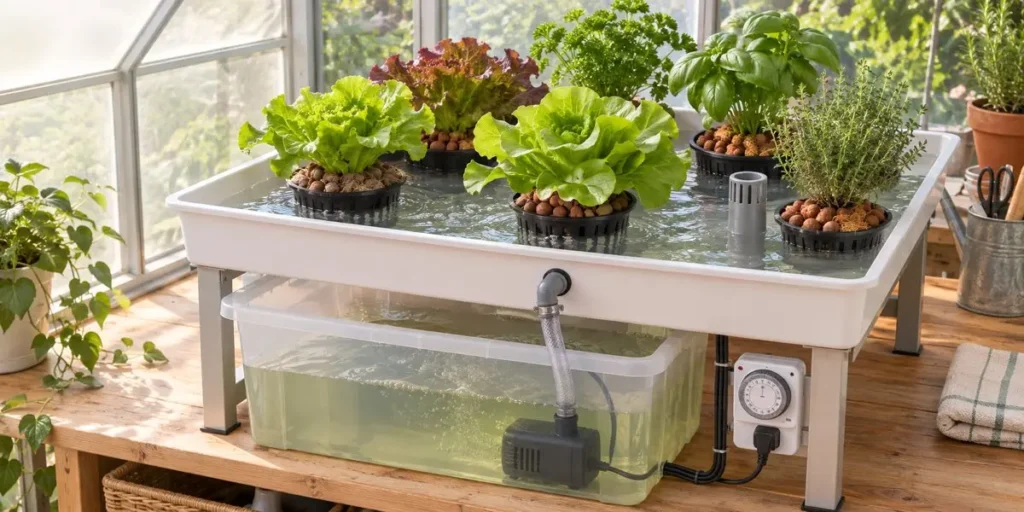
A basic setup includes a reservoir, a submersible pump, a timer, a flood tray, fill and drain fittings, and containers for the plants. When the timer switches the pump on, the tray fills to a set level. When the pump stops, the solution drains back into the tank and the roots are left in moist medium with air around them.
The Flood, Soak, and Drain Cycle
One thing to keep in mind is that a pump cycle is not the same as a watering cycle. When the pump runs for ten minutes, the tray may take several minutes to reach its set depth, the medium may need another few minutes to take up water, and the remaining solution still has to drain away.
This matters because two trays can share the same timer setting and behave very differently. A deeper pot, a finer medium, or a longer run of tubing can all change how long the water takes to reach the plants. A setting that works in one setup is a starting point, not a rule you can copy.
During the drain, air returns to the pore spaces in the medium. That exchange is the reason ebb and flow works as well as it does. The roots need water, but they also need oxygen between cycles, and the drain phase is what makes that possible.
How Deep Should You Flood an Ebb and Flow Tray?
There is no single depth that suits every system, but there is a reliable way to find the right one for yours. Start with a waterline that can wet the active root zone or the bottom of the starter plug, then check how high the moisture actually reached after the tray drains.
Oregon State University Extension suggests flooding to about an inch below the top of the growing medium, letting the medium soak until it looks glistening, and then draining it away. That is a sensible starting point for a full pot of medium, but your pot height, medium type, and seedling size will still decide what the plant receives.
Why the Same Flood Depth Wets Pots Differently
Two trays can flood to the same depth and still deliver very different amounts of water to the plants. Clay pebbles drain quickly and hold little water, so the moisture may only reach the lower part of the pot. Coco coir holds more and can stay wet well above the visible waterline. Rockwool can hold even more, and a dense block may remain saturated long after the tray drains.
A seedling plug that sits above the wetted layer may never make contact with the solution at all. In that case the tray looks correctly filled, but the plant is effectively dry.
Because of this, treat the waterline as a starting setting rather than a fixed number. If you change the growing medium, the pot size, or the height of the containers in the tray, test the setup again before assuming the old setting still works. After a cycle, lift one representative pot and look at the medium to see how high the moisture climbed, not just whether the bottom is wet.
How Often Should You Flood an Ebb and Flow System?
The right interval depends on the medium, the pot size, the temperature, and how much water the plants are using. Instead of following a fixed schedule, check the root zone just before the next flood and adjust from there.
In one r/Hydroponics discussion about ebb and flow buckets filled with clay pebbles, growers reported schedules that ranged from twice a day to once an hour. The difference was not a disagreement about the method. It came from different pot sizes, different media, and different pumps. A schedule from one system does not transfer directly to another, and it is worth being cautious when a thread about buckets is used to answer a question about a tray.
How to Tell When the Root Zone Needs More Water
An empty tray does not mean the pots are ready for another flood. A dense or water-retentive medium can stay wet below a surface that looks dry, and a pot sitting in a low spot can keep part of the root zone saturated long after the tray appears to have drained.
This is why checking the medium at root depth is more useful than watching the tray. It also explains why two growers can use the same timer setting and get different results. The timer decides when water enters the tray. The medium and the plant decide how long that water stays available.
Before the next cycle, check whether the medium is still comfortably moist. When it has dried too far, the interval may be too long. A pot that is still heavy and wet is a sign to check the drainage before adding another cycle.
How to Test Ebb and Flow Flood Depth and Timing
If you are not sure whether your schedule is working, choose three comparable pots and weigh them at the same points in the cycle. Choose one near the inlet, one in the middle, and one at the far end, and keep the plants and the medium as similar as you can.
Weigh each pot before the flood, after the tray has drained, and again just before the next cycle. This gives you a simple record of how much water each pot is holding and how quickly it is drying.
If the weights differ a lot, check the tray level, the inlet position, and whether the pots are making good contact with the wetted layer. This kind of test takes a few minutes, but it is more reliable than guessing from the surface of the medium.
Why You Should Change One Setting at a Time
Once you have a record, change only one thing and repeat the test. If you raise the water level and shorten the interval at the same time, it becomes difficult to know which change helped.
A simple notebook with the flood depth, the time to reach that depth, the drain time, and the pot weight is enough to keep track of what you are doing. That record becomes more useful with each cycle, because it describes your own system rather than someone else’s.
Ebb and Flow System Parts That Affect Drainage
The main components of an ebb and flow system are fairly simple, but each one affects how well the system drains. A pump that is too weak can make the fill slow, while a pump that is too strong can overwhelm the drain path. The tray, the fittings, and the pots all matter as well.
How to Size a Pump for the Lift Height
A pump rated for a large flow at zero lift may deliver much less through tubing, elbows, and vertical height. Check the pump curve at the height your system actually needs, and then check the result in the installed setup by timing how long the tray takes to reach its set depth.
If the tray fills slowly, look at the inlet, the filter, and the tubing before assuming the pump is failing. If the tray fills too quickly and the overflow struggles to keep up, the pump may be stronger than the drain path can handle. In layouts that use a standpipe to set the water level, the overflow needs to handle the incoming flow.
How to Check Reservoir Levels During the Cycle
At full flood, the pump still needs enough submergence to run properly, and after the solution returns, the reservoir needs enough headroom for the next cycle. Both levels should be checked with the intended number of pots in place.
A reservoir that works with an empty tray may overflow once the pots and medium displace water. Marking both levels on the tank is a simple way to avoid this problem, and it makes routine checks much faster.
How to Fix Low Spots After the Tray Drains
A tray does not have to look crooked to cause a problem. Under the weight of wet pots, one corner can settle just enough to hold a shallow puddle. That puddle keeps the medium in that corner wet while the rest of the tray drains normally.
Look for water that remains under the containers after the rest of the tray drains. Check the drainage channels and the screen, and check the tray level with the pots in place. A small shim can fix a low corner. Ignoring it can leave the same plants wet for weeks.
What Recirculation Saves in Ebb and Flow
Recirculation saves water and nutrients because the solution returns to the reservoir instead of being discarded after every cycle. That is one of the practical advantages of ebb and flow, especially for home growers who want to use resources efficiently.
At the same time, a shared reservoir connects every pot in the system. Water that passes through one pot can return to the tank and move to another, which is worth keeping in mind when a plant is struggling.
The EC reading in the reservoir tells you about the overall concentration of dissolved salts in the solution. It does not tell you what is happening in the growing medium, and it cannot identify individual nutrients.
With bottom watering, salts can accumulate in the upper part of the medium over time. If plants show symptoms while the tank reading looks normal, check the medium and consider how long the solution has been running through the system. EC is a useful trend, not a complete diagnosis.
Root Health in a Shared Reservoir
Recirculating water can move some root pathogens from one pot to another. That does not mean every shared system will have a problem, but it does mean that a pot with damaged or discolored roots deserves attention before the next cycle.
Removing the affected pot from the shared loop, cleaning the accessible fittings, and checking the reservoir are simple steps that can keep a small issue from becoming a larger one. A separate container for a suspect plant is often easier to manage than treating the whole tray.
Troubleshooting by What You See
| Symptom | First check | What the result tells you | Next step |
|---|---|---|---|
| Near pots are wet, far pots are dry | Compare water depth and pot weight at both ends | The tray may not be level, or the flow may be uneven | Level the tray, clear the inlet, and test again |
| One corner stays wet | Look for water under the pots after drainage | A low spot or a blocked channel is trapping water | Clear the channel and shim the low corner |
| Pump runs but the tray fills slowly | Check the inlet, the filter, the tubing, and the operating lift | The pump may be restricted or undersized for the actual height | Clean the line and check the pump curve |
| All pots wilt | Check the root-zone moisture before the next flood | The interval may be too long, or the pump may not be running | Check the timer and the pump before changing the schedule |
What Happens If the Pump Stops Mid-Flood?
Before the plants go into the system, run a plain water test and turn the pump off halfway through a flood. Watch where the water returns and whether any part of the tray holds water. This is the easiest way to find a drainage problem before it affects a crop.
Then check how the timer restarts after the interruption. Some timers resume the cycle, while others wait for the next scheduled start. Knowing which one you have makes a difference after a short power cut.
It also gives you an idea of how much time you have if the pump fails during a grow. A coarse medium may dry quickly, while a water-retentive medium may hold moisture for longer. Knowing how your system behaves makes it easier to respond if something stops working.
Best Plants and Layouts for Ebb and Flow
Ebb and flow is easiest to manage when the plants on a tray have similar watering needs and grow in similarly sized pots. Lettuce seedlings, potted herbs, or peppers at the same growth stage can usually share a schedule. Mix small starter plugs with mature plants, though, and some pots may dry out between floods while others stay wet.
If tomatoes are your main crop, Dutch buckets can give each plant more root space and make it easier to install supports and reach individual plants for pruning and harvest. If you’re growing crops with different watering needs, split them across separate trays or irrigation zones so you can adjust each schedule independently.
Ebb and Flow vs NFT, DWC, and Dutch Buckets
These systems control different parts of the growing environment. Ebb and flow manages how a tray floods and drains. NFT relies on a steady flow through channels. DWC focuses on oxygen in the root solution. Dutch buckets give each plant its own container and more room for larger root systems.
For small plants and uniform crops, ebb and flow is often the practical choice. Mature tomatoes and peppers need more root space, support, and access for maintenance, so Dutch bucket hydroponics is often a better fit. The main decision is whether you want one shared irrigation schedule or individual containers you can inspect and adjust.
Ebb and Flow Hydroponics FAQ
There is no single schedule that works for every setup. In a r/Hydroponics discussion, growers described schedules from twice a day to once an hour, and the difference came from the pot size, the medium, and the pump. Checking the root-zone moisture before the next cycle is more reliable than copying a timer setting.
You can check the driest representative pot just before the lights come on. If the root zone has dried too far, testing one overnight cycle and checking the result the next morning is a reasonable approach. If the pot is still wet, the drainage needs attention before more water is added.
Algae can appear where water remains in grooves or low spots after the tray drains, especially if light reaches those areas. Keeping the tray level, clearing the drainage channels, and wiping exposed surfaces are usually enough to keep the problem manageable.
A deeper waterline means more water has to enter the tray and more has to drain back out. One grower measured roughly 12 minutes for a cycle at a 2-inch setting and about 20 minutes at 3¾ inches. Those times belong to that particular setup, but the principle applies to most systems: after changing the standpipe, measure the fill and drain times again.
Yes. Both terms describe the same method of periodically flooding the root zone and then letting the solution drain back into the reservoir. The tray can hold individual pots or a full bed of growing medium, but the cycle is the same.
Is Ebb and Flow Right for Your Setup?
The quickest answer is to watch how one full cycle behaves rather than how neat the setup looks. Check a pot near the inlet, one in the middle, and one at the far end. After the tray drains, they should hold broadly similar amounts of water, and they should be ready for the next flood at roughly the same time. If one pot stays unusually heavy while another dries out, the issue is probably tray level, drainage, pot contact, or water movement rather than the timer itself.
The system is usually a good fit when you grow a group of plants with similar water needs, can reach the reservoir easily, and are willing to check the root zone instead of trusting a copied schedule. It becomes harder to manage when small starter plugs and mature plants share one tray, when the tray is difficult to level, or when every crop needs a different watering rhythm. In those cases, smaller trays or a different system may save more work than they cost.
The short version: flood deep enough to wet the active root zone, let the medium absorb what it can, make sure the tray drains, and check the pots before starting the next cycle. A timer begins the cycle; the plants and the medium tell you whether the setting is working.
If you remember only one thing, make it the pot test. It turns vague advice about watering more or less into a measurement you can repeat on your own system.
Compare the Layout Before You Choose Your System
If you are planning a crop of mature fruiting plants, it is worth comparing a shared flood tray with a Dutch bucket layout before you build. The main difference is how the irrigation is controlled and how easily you can reach an individual plant.
At Greenfuture Hydro, we design and manufacture hydroponic systems for home growers, greenhouses, and larger growing projects. You can browse our hydroponic systems or contact us with details about your space, crops, and maintenance routine. We will be glad to help you compare a tray system with a bucket layout.
📩 info@greenfuturehydro.com
📞 +86 13487543942
📷 Instagram @Greenfuturehydro